
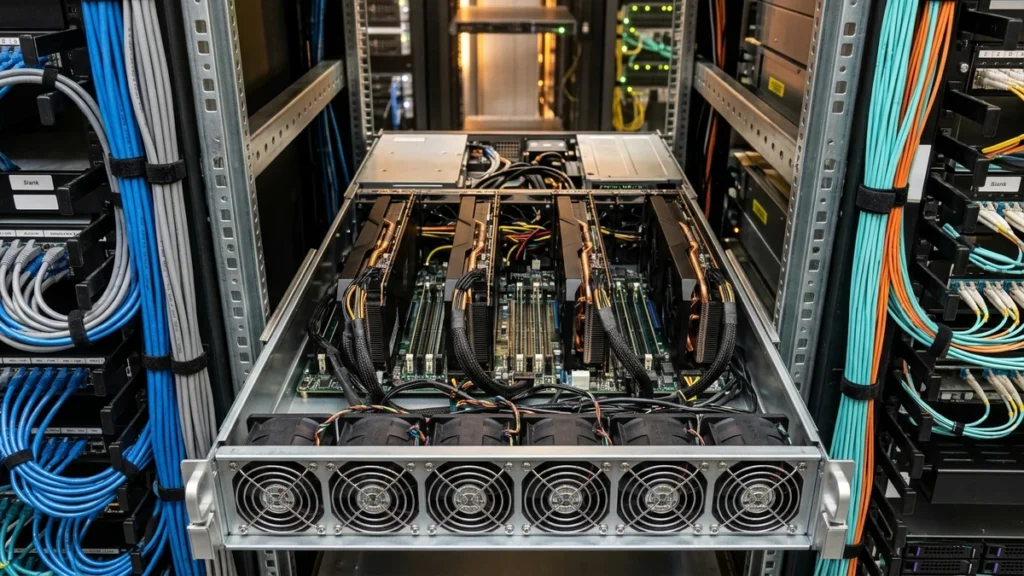
Database Mart GPU and SQL Server Hosting: Published Specs, Latency Checks — Overall Audit
Database Mart's GPU dedicated and SQL Server plans as published in Nov 2026, compared with Cherry Servers, plus how to measure network and disk latency.
Database Mart sells dedicated GPU servers and SQL Server hosting from two US data centers. This review covers what its own pages publish as of 5 November 2026: plans, prices, hardware, licensing and locations. We did not run latency, throughput or GPU benchmarks on Database Mart or on Cherry Servers, the comparison provider. Instead, the second half of the page shows how to measure the latency that matters for a SQL Server or GPU workload yourself, using the test endpoints Database Mart publishes.
Where the servers are
Database Mart’s data-center page lists two US facilities: Dallas, Texas (South US) and North Kansas City, Missouri (Central US). The Kansas City page names peering at AMS-IX, DE-CIX and SIX and lists bandwidth providers including Zayo, AT&T and Hurricane Electric. Dallas lists 2N+1 UPS and N+2 cooling but no carrier list. Both sites publish a ping test IP and a 100 MB download file, which is exactly what you need for a latency check before ordering. GPU and SQL plan cards simply say “USA”, so ask which facility a specific plan ships from.
Cherry Servers, by comparison, lists seven regions in its public API: Šiauliai (Lithuania), Amsterdam, Frankfurt, Stockholm, Chicago, Singapore and Tokyo. If your users are in Europe or Asia, round-trip time alone may decide between the two before price does.
Published GPU dedicated plans (selection)
| Plan (Database Mart) | GPU / VRAM | CPU | RAM | Storage | Port | Price/mo |
|---|---|---|---|---|---|---|
| Basic – RTX 4060 | RTX 4060, 8 GB GDDR6 | 8-core E5-2690 | 64 GB | 120 GB SSD + 960 GB SSD | 100 Mbps unmetered | $149 |
| Advanced – RTX A5000 | RTX A5000, 24 GB GDDR6 | 2 x 12-core E5-2697v2 | 128 GB | 240 GB SSD + 2 TB SSD | 100 Mbps unmetered | $174.50 (list $349, “save 50%”) |
| Enterprise – RTX 4090 | RTX 4090, 24 GB GDDR6X | 2 x 18-core E5-2697v4 | 256 GB | 240 GB SSD + 2 TB NVMe + 8 TB SATA | 100 Mbps unmetered | $409 |
| Enterprise – A100 40GB | A100, 40 GB HBM2 | 2 x 18-core E5-2697v4 | 256 GB | 240 GB SSD + 2 TB NVMe + 8 TB SATA | 100 Mbps unmetered | $639 |
| Enterprise – H100 | H100, 80 GB | 2 x 18-core E5-2697v4 | 256 GB | 240 GB SSD + 2 TB NVMe + 8 TB SATA | 100 Mbps unmetered | $2,099 |
| Multi-GPU – 4 x A100 | 4 x A100, 40 GB each, 6x NVLink | 2 x 22-core E5-2699v4 | 512 GB | 240 GB SSD + 4 TB NVMe + 16 TB SATA | 1,000 Mbps unmetered | $1,899 |
The pattern across the 29 published GPU cards is consistent: current-generation GPUs paired with Xeon E5 host CPUs, single-GPU plans on a 100 Mbps port and multi-GPU plans on 1 Gbps. For training or batch inference where data is staged locally, the 100 Mbps port matters less. For serving models to remote clients, or pulling large datasets, it becomes the bottleneck: a 100 GB dataset takes at least about 2.2 hours to download at a sustained 100 Mbps, before any protocol overhead.
Need a dedicated GPU in a US data center?
Monthly dedicated GPU servers from entry cards to multi-GPU NVLink builds, with Windows or Linux and a published SLA of 99.9% availability.
Browse dedicated GPU plans →SQL Server hosting: plans and licensing
The SQL Server page has two tiers. Windows VPS plans come with SQL Server Express pre-installed by default and run from $10.99/month (3 cores, 6 GB RAM, 100 GB SSD, 100 Mbps) to $63.99/month (16 cores, 32 GB, 400 GB SSD, 500 Mbps). Dedicated SQL plans on the page are SATA-based: Express Dedicated at $37.80/month (E3-1230, 16 GB, 240 GB SSD + 5 TB SATA, labelled “save 30%” from $54) up to Advanced Dedicated at $179/month (2 x E5-2667v3, 128 GB, 120 GB SSD + 12 x 8 TB SATA).
Licensing is the part to read carefully:
- Express 2022: free, 10 GB maximum database size, 1 GB buffer pool, 4-core cap, no SQL Agent.
- Express 2025: free, 50 GB maximum database size, same 1 GB buffer pool and 4-core cap.
- Web 2022: $29/month per 4 cores, 64 GB buffer pool, 16-core cap, SQL Agent included.
- Bring-your-own-licence is mentioned for anything beyond Express or Web, without pricing.
The 1 GB buffer pool on Express is the hidden latency factor. If your working set is larger, reads go to disk, and on a SATA-heavy dedicated build that means disk latency, not CPU, sets query time. Cherry Servers’ docs, by contrast, state that its dedicated range uses NVMe SSDs, while Windows is an extra monthly fee that its docs give as a range of €160 to €2,560 depending on the server.
How to measure latency yourself
Network round trip
- From the machine or region where your application servers or users sit, ping the test IP that Database Mart publishes for each facility. Run at least 100 packets and note average and maximum.
- Run
mtr -rwc 100to the same IP to see where loss or jitter appears along the path. - Download the published 100 MB test file and time it. At 100 Mbps, the theoretical floor is about 8 seconds, so anything much slower points to path congestion.
- Repeat the same three steps against a trial Cherry Servers instance in the region you are considering.
SQL Server storage latency
Once a trial server is running, Microsoft’s sys.dm_io_virtual_file_stats view reports cumulative reads, writes and I/O stall time per database file. Dividing io_stall_read_ms by num_of_reads (and the write equivalents) gives average read and write latency per file. Capture it before and after a representative workload and compare the delta, since the counters accumulate from instance start.
Raw disk
fio runs on Windows using the windowsaio engine and on Linux with libaio. A 4K random write at queue depth 1 with sync writes approximates log-flush behaviour; a 4K random read at queue depth 32 approximates buffer-pool misses under load. Record p99 completion latency, not just IOPS.
Pros and cons
Database Mart
- Pro: broad GPU range on monthly dedicated terms, from entry Quadro cards to H100 and 4 x A100 with NVLink.
- Pro: SQL Server Express pre-installed free; Web edition priced openly at $29/month per 4 cores.
- Pro: publishes test IPs and download files for both data centers.
- Con: US-only, two locations; plan cards do not say which one.
- Con: 100 Mbps ports on single-GPU plans; older Xeon E5 host CPUs; SQL dedicated cards listed with SATA storage.
- Con: several prices are promotional with no stated end date.
Cherry Servers
- Pro: seven regions across Europe, the US and Asia; NVMe across dedicated servers; hourly, monthly and annual billing.
- Pro: current CPUs on bare metal, for example AMD EPYC 9354P with 192 GB RAM, 2 x 1 TB NVMe and a 10 Gbps port at €549/month excluding VAT.
- Con: Windows licensing is a separate, sizeable monthly fee; GPU is an optional add-on on select servers only, with models not listed in the docs.
Verdict
Database Mart is a reasonable fit when you want a specific GPU on a monthly dedicated contract in the central or southern US, or a low-cost SQL Server Express or Web host and can live within those editions’ limits. Its weak points for latency-sensitive work are the 100 Mbps ports and SATA-based SQL dedicated builds. If your database needs NVMe, current-generation CPUs or a location outside the US, Cherry Servers’ bare metal is the alternative to price out, keeping the Windows fee in the calculation. Either way, run the ping, mtr and DMV checks above on a trial server before you sign a long term.
FAQ
Where are Database Mart’s data centers?
Dallas, Texas and North Kansas City, Missouri, according to its data-center page. Plan cards list only “USA”, so confirm the facility when ordering.
Is SQL Server included in the price?
Express is pre-installed free on the Windows VPS plans and is optional and free elsewhere. Web 2022 is a paid add-on at $29/month per 4 cores. Other editions are bring-your-own-licence.
What network port do the GPU servers have?
Single-GPU plans list 100 Mbps unmetered; the multi-GPU plans list 1,000 Mbps unmetered.
How do I check latency before buying?
Ping and run mtr against the test IPs on Database Mart’s data-center page from where your users are, and time the 100 MB test file. After provisioning, use sys.dm_io_virtual_file_stats for SQL Server file latency.
Does Cherry Servers offer GPU servers?
Its documentation says a GPU is optional on select dedicated servers through hardware customization, but it does not list GPU models, so request a quote for the card you need.
Need NVMe bare metal outside the US?
Dedicated servers with current AMD EPYC and Ryzen CPUs, local NVMe and hourly or monthly billing across European, US and Asian regions.
Compare bare metal servers →Database Mart GPU and SQL Server Hosting — Production Readiness Summary
Database Mart's GPU dedicated and SQL Server plans as published in Nov 2026, compared with Cherry Servers, plus how to measure network and disk latency.
FTC & Affiliate Disclosure: FoxyData may earn a commission via partner links at no additional cost to you.